


Revelation 13:18 presents a number and asks the reader to do something with it.
“This calls for wisdom. Let the person who has insight calculate the number of the beast, for it is the number of a man. That number is 666.” — NIV
The number is already identified as belonging to the beast. Yet the passage calls for wisdom and calculation.
There are longstanding interpretations of this number, particularly those connecting it to historical figures through numerical values assigned to letters.
But I want to examine another possibility.
What if the repetition of six helps us recognise something about the way authority can become disconnected from its origin?
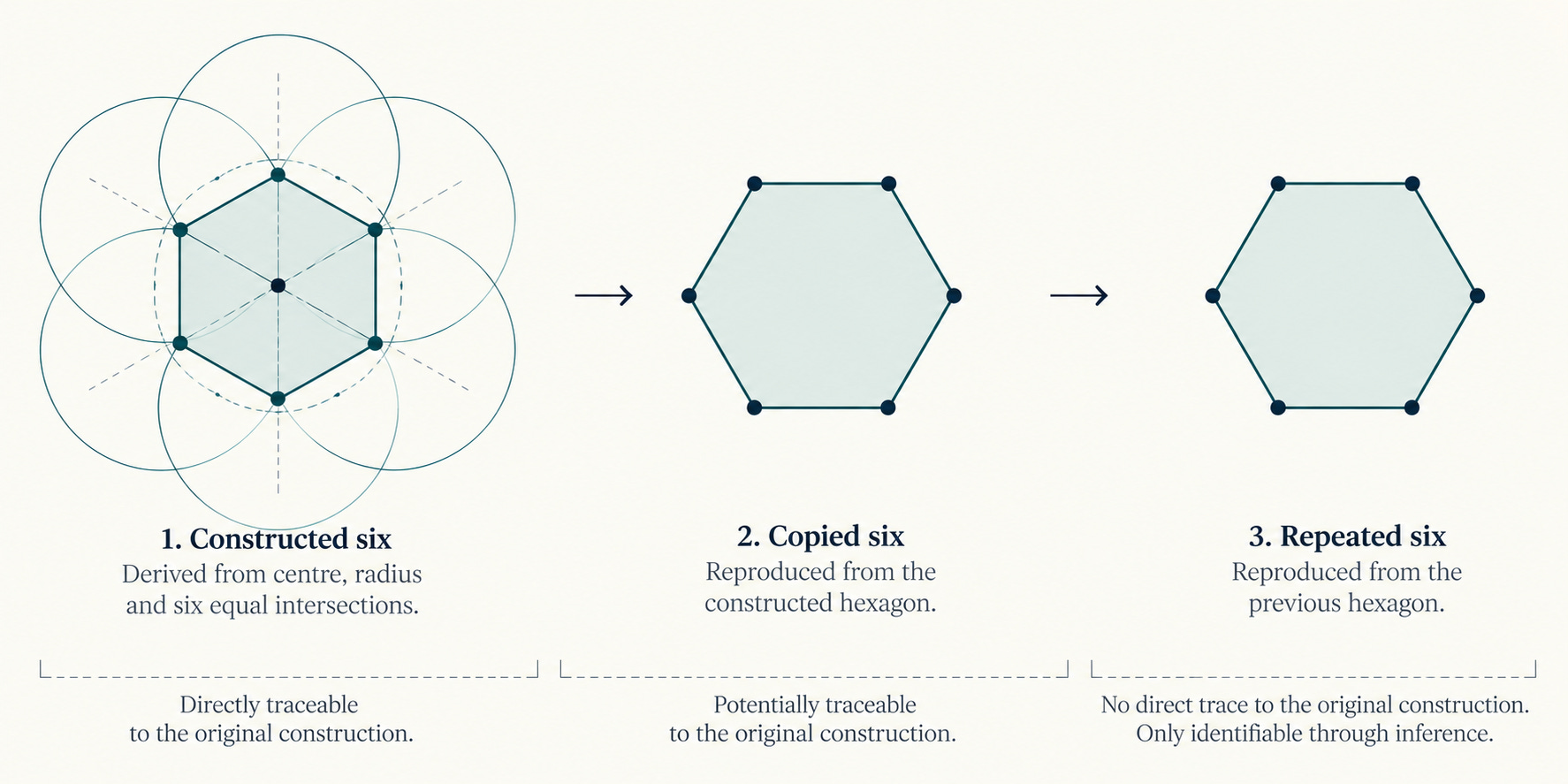
The first six: Construction
Consider a circle.
Using the same radius, we can construct six equally spaced points around its circumference. Drawing circles from those points produces a flower-like arrangement of overlapping circles.
Connect the six points, and a regular hexagon becomes visible.
The hexagon has six equal sides, but six was not the instruction that produced it.
Its form emerged from relationships between the centre, radius, circumference and intersections.
The construction makes those relationships visible.
We can see where the hexagon came from.
The second six: Recognition
Now remove the construction circles.
The hexagon remains.
It still has six equal sides. Its angles remain unchanged. It is recognisably the same geometry.
We could examine its dimensions and reconstruct the circles that would produce it.
But we have already lost something.
We can demonstrate how such a hexagon could be constructed. We cannot establish from the hexagon alone that this was how the original was actually made.
The geometry remains available. The history of its construction does not.
That distinction matters.
The third six: Repetition
Now reproduce the hexagon using the second hexagon as the reference.
We have another six.
The new hexagon may be perfectly accurate. We can compare its sides and angles with the previous one and confirm that they match.
But what have we actually established?
That the third resembles the second.
And that the second resembles the first.
We have not independently recovered the original construction.
We can reason backwards, propose a likely method and demonstrate that the method produces the same result.
Yet a convincing reconstruction is not necessarily evidence of what actually happened.
Anyone familiar with copying patterns, templates or drawings will recognise the practical problem. Each copy can become the reference for the next. Sometimes errors accumulate. Sometimes they don’t.
Even when every copy is accurate, the original construction may no longer be known.
The structure continues to function. What has been lost is the ability to establish its origin from the structure alone.
Why 666?
This is what interests me about the repetition.
One six is visible through its construction.
A second six remains recognisable after the construction has been removed.
A third six can be reproduced from that recognisable form without ever encountering the original relationships.
The number itself does not demonstrate this interpretation. Nor am I suggesting that the biblical author necessarily had a geometric construction in mind.
I am asking whether these three stages offer a useful way of examining the warning in Revelation.
Because the chapter describes something remarkably relevant: authority being passed through successive representations.
Tracing the beast
In Revelation 13, the dragon gives authority to the first beast.
A second beast exercises the authority of the first.
An image of the beast is constructed, and people are compelled to recognise its authority. Participation in buying and selling becomes conditional on the mark, name or number associated with the beast.
There is a progression.
Authority is received, exercised, represented and enforced.
If we ask where the image’s authority comes from, we can trace it to the beast.
If we ask where the beast’s authority comes from, we arrive at the dragon.
Revelation 12 identifies the dragon as the ancient serpent, the devil or Satan.
But does the trace end there?
Within the biblical understanding of creation, even the serpent is not an independent origin.
God is understood as the source of creation.
This does not mean God authorises the serpent’s actions. It means that the source of something’s existence must be distinguished from the authority it subsequently claims or exercises.
And that distinction is central to the question.
We can trace the beast’s authority to the dragon without establishing that the dragon is the ultimate source of everything involved.
Just as we can trace a copied hexagon to the previous hexagon without recovering the construction that first made it possible.
When recognition replaces understanding
There is nothing inherently wrong with reproduction.
We depend on inherited knowledge, established methods, traditions and structures. We cannot personally reconstruct the origin of everything we use.
But there is a danger when the successful reproduction of a structure becomes sufficient justification for the authority claimed through it.
A pattern can remain recognisable long after the process that established it has been forgotten.
And once the pattern itself becomes the reference, people may begin defending it through comparison with earlier copies.
The dimensions match.
The appearance matches.
The accepted explanation matches.
But those comparisons do not necessarily recover what originally happened.
Sometimes the more responsible approach is to return to the available source conditions and construct again, rather than continue justifying a reproduction through other reproductions.
And sometimes the original source is no longer available.
That is when we need to recognise the limits of what we know.
A warning that includes us
Perhaps one of the dangers in reading Revelation is assuming that the warning concerns someone else.
The beast. The devil. A future ruler. An institution.
We identify the threat, and the inquiry ends there.
But we are also participants in structures of inherited authority.
We reproduce knowledge, repeat explanations, defend traditions and make judgements based on references we did not establish ourselves.
We may do all of this competently and sincerely.
The question is whether we still recognise the difference between what we can demonstrate, what we have inherited and what we can only infer.
Under this interpretation, 666 is not simply a number pointing towards an external enemy.
It becomes a possible warning about our own relationship with knowledge and authority.
About how a derived structure can continue functioning while our recognition of its origin becomes increasingly uncertain.
And about what happens when we treat that structure as though it no longer needs to be questioned.
Returning to the instruction
Revelation does not merely give the reader a number.
It calls for wisdom.
I don’t claim that the geometric progression of six, six and six establishes the intended meaning of the passage. Historical interpretations, including the ancient manuscript reading of 616, remain important challenges to this proposal.
But the question raised by the construction is one I think deserves examination.
How do we distinguish a structure that can be reproduced from a source that can actually be traced?
And when the source is no longer available, are we willing to acknowledge that our explanation may be a reconstruction rather than a recovered origin?
Perhaps wisdom begins, at least in part, with recognising that distinction.
Not simply asking whether the pattern is correct.
But asking what made it possible, what we can genuinely know about that origin, and where our own trace has ended.