


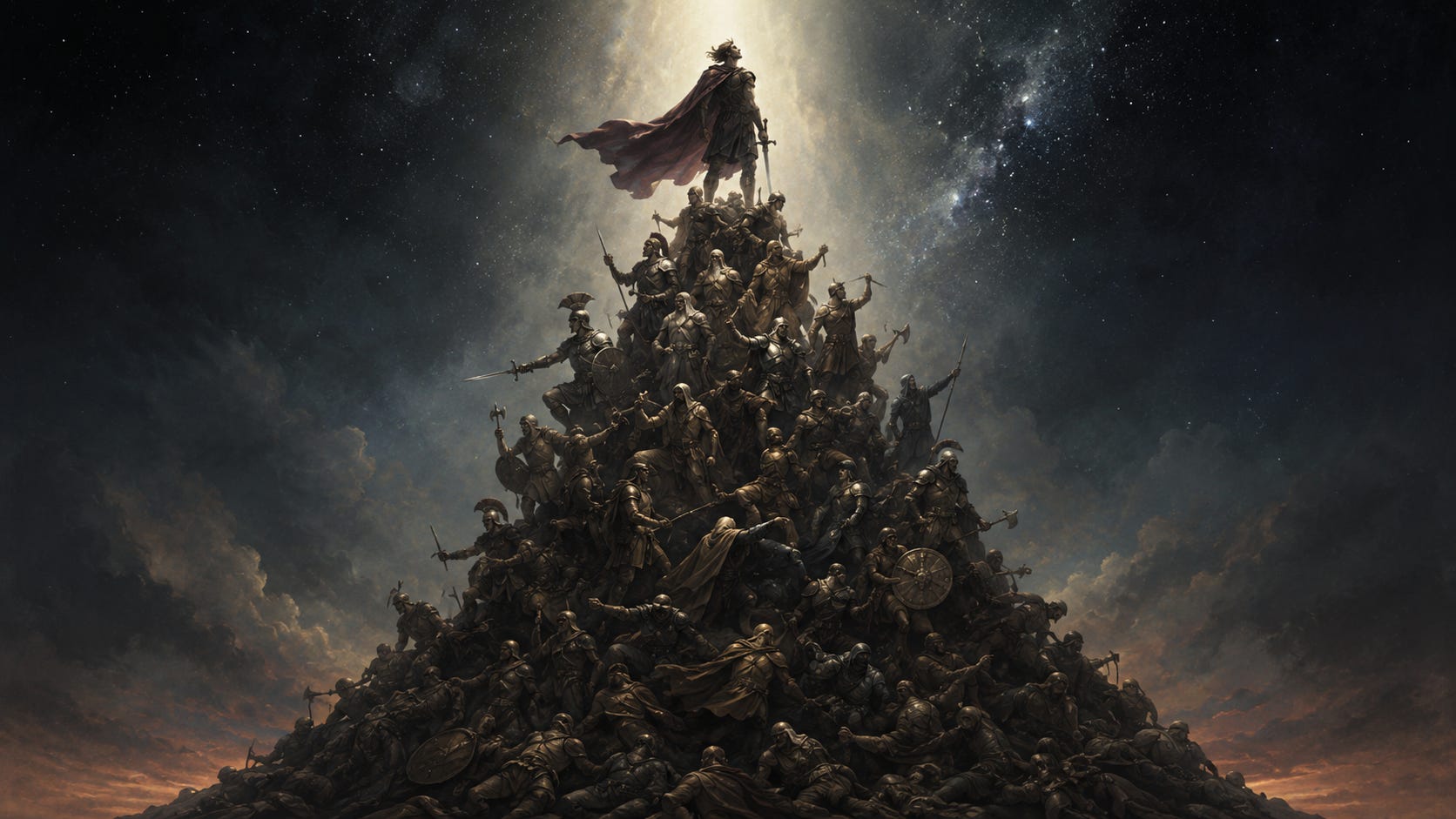
How does a story crossing generations remain available as one story?
The visible events of Star Wars belong to Jedi, rebels, rulers, families and empires. But events do not become history simply because they occur. Something must retain what happened, carry it across difference, and remain present long enough for separated events to continue as one story.
Two droids in a corridor
The first released Star Wars film opens at the scale of empire. A smaller ship is pursued by a larger one, soldiers prepare to defend its doors, a princess carries stolen plans, and Darth Vader enters through smoke and bodies.
But the first sustained exchange belongs to two droids.
C-3PO worries. R2-D2 continues.
They command nothing and hold no political or military authority. Across the films they are captured, sold, damaged, repaired and moved between owners. Yet the story stays close to them. Powerful figures enter and leave, generations rise and pass, the Republic becomes an Empire, the Empire falls and another power rises in its place, while the droids keep moving between them.
They are not merely present throughout the story. They are what allows the story to remain continuous.
Calibration
R2-D2 is an astromech droid, calibrated towards maintenance, navigation and interaction with machinery. His work places him beneath the visible action: inside ships, control systems and damaged infrastructure, where routes are stored, messages received and passages reopened.
Leia places the Death Star plans in his memory because he can carry them. He carries her message to Obi-Wan and retains recordings, coordinates, identities and prior events that later participants cannot otherwise reach. His function gives him access to the hidden structure through which the visible story continues.
C-3PO is calibrated differently. He is made for language, protocol and communication between participants, and he reads speech, custom, etiquette, danger and consequence. This is why he worries.
His anxiety is often treated as comic weakness beside R2’s confidence, but C-3PO is repeatedly responsible for recognising what others are entering. He hears the insult, notices the breached custom, calculates the risk, and knows that an action which appears harmless to one participant may carry a very different meaning to another.
On Endor, his most important operation is not mechanical. He tells a story.
The Ewoks have encountered strangers whose purpose they cannot yet read, and C-3PO translates the conflict into a form they can receive. The story changes the relation. Those who were separate become capable of acting together.
Translation does not win the battle by itself, but without translation, participants who could help one another remain divided by an unreadable boundary.
R2 carries continuity through interruption. C-3PO carries continuity across difference.
It would still be too simple to say that R2 remembers while C-3PO translates. Both remember. Both interpret. Both recognise others, respond to danger and participate in what follows. They are not two exclusive kinds, but differently weighted participants within a shared field.
R2 is strongly calibrated towards retained orientation: systems, routes, records and the path back through what has happened. C-3PO is strongly calibrated towards relational readability: language, custom, consequence and the passage between participants.
These are polarities, not a binary division. A polarity does not separate the world into two sealed types. It makes a field readable by showing where different weights gather within it.
R2 often proceeds because he retains a path others cannot yet see. C-3PO hesitates because he reads consequences others have not yet noticed. Their personalities are not decorations placed over machinery. Their repeated functions are what make their dispositions intelligible.
Memory under interruption
The relation between the droids becomes clearest when memory is broken.
At the end of the prequel story, C-3PO’s memory is erased. His ability to speak and translate remains, but his direct continuity with what he witnessed is cut. He remains recognisably C-3PO, yet he can no longer follow the whole path through which he arrived there.
R2’s memory remains. The quieter droid carries knowledge of a world the speaking droid can no longer recall.
Much later, C-3PO accepts another erasure so that he can translate information the others need. His function continues, but the cost is his remembered participation. R2 retains a backup, and the one calibrated towards translation is restored by the one calibrated towards continuity.
This does not prove that one droid is memory and the other is language. It shows why their coupling matters. A record may survive while becoming unavailable to others. A fluent participant may continue speaking after losing the trace that connects that speech to prior events.
Memory needs translation, and translation needs memory. The story continues through the relation between them.
The witnesses mistaken for servants
The Skywalker family carries the visible lineage of Star Wars, but bloodline does not carry the whole history.
Luke and Leia inherit the consequences of events whose causes have been hidden from them. They receive the structure before they receive its trace. Obi-Wan knows part of what happened. Yoda knows part. Vader carries part beneath another identity. Each living witness is bounded by position, allegiance, pain and mortality.
The droids pass between those boundaries. They serve queens, senators, farmers, Jedi, smugglers, rebels and generals, moving between domestic life and war, between the central event and the infrastructure beneath it.
Their low position does not reduce their importance. It is part of what makes their carrying possible. A hero becomes known and therefore becomes a target. A ruler is watched. A soldier receives the direct force of conflict. A maintenance droid may pass beneath attention because systems still need to function, regardless of who controls them.
The story survives because its witnesses are mistaken for servants.
The carrier beneath the story
Epic stories direct attention towards visible action. A ruler gives a command. A hero makes a choice. An army advances. A people escape.
But none of those events reaches another generation by itself. Something must carry enough through the rupture for continuation to remain available.
Genesis places this condition inside the flood. The Ark does not defeat the water. It carries a living remainder through the end of one inhabited world and into the possibility of another. The later world receives most of the attention, but there is no later world without the carrier.
Exodus opens on a different destruction. Pharaoh commands that Hebrew sons be killed at birth, and before Moses can lead anyone, the midwives refuse to complete that command. Women carry life beneath an authority that has marked it for removal.
Moses’s mother bears him, hides him and protects him for as long as her immediate conditions allow. When that form of carrying can continue no further, she makes another. The basket extends her care beyond what her own body and hiding place can hold.
Moses does not begin as the carrier of a people. He begins as what others refuse to let be lost.
The Ark and the basket matter, but neither is sovereign. Each is made, placed, watched and received through relations of care. Before a visible continuation appears, a quieter relation has already refused its loss.
The same condition appears in Star Wars at the level of story. The droids do not defeat the rupture. They carry enough through it for separated events to remain part of one history.
The Ark carries life. The women of Exodus carry a person through whom a people will continue. The droids carry the readable trace through which a story reaches another participant.
The maker
A story working across generations presents a structural problem: who can remain present long enough for it to retain a continuous witness?
A human character belongs to a particular lifetime, and the span of the telling may exceed it. A ruler or hero influences events too strongly to remain only a witness, because whatever they see, they also change. A voice entirely outside the world can span anything, but it shares none of the world’s vulnerability and has nothing at risk in the carrying.
The droids occupy another position. They remain inside the events without becoming their sovereign centre. Their functions make them useful across households, factions and generations, and that usefulness gives them passage. They can witness history while appearing to be equipment within it.
Lucas later described The Hidden Fortress and its two low-status characters as an important influence on the placement of the two droids. The choice was not merely decoration or comic relief. It was a decision about where a story could be witnessed from, received from a filmmaker who had already made that position available.
This is where the reading turns back on itself.
Lucas is not overlooked. He is the most visible name attached to the work, which is the opposite condition from the droids, who carry partly because attention passes over them. If the argument applied only to the unnoticed, it would stop here.
It does not stop, because visibility does not exempt anyone from having been carried.
Lucas made the droids, but Lucas also received: films, serials, myths, war footage, and the work of the collaborators who built, cut, scored and shot what he had described.
The position of origin is not a property of a person. It is an effect of where a trace is stopped.
Anyone appears as an origin from one direction and as a recipient from the other. Which of those we see depends on how far back we are willing to keep going.
The maker is therefore not an ultimate beginning. The maker is another participant reached by tracing backward, and one who was himself carried by witnesses who did not rule what followed.
Whether or not every later continuation was known from the start, the arrangement produced two figures capable of holding continuity across a span no ordinary human witness could keep intact. The storyteller makes the witnesses. The witnesses carry the story. The story allows later participants to recover the storyteller, and those participants then carry the read elsewhere.
The trace does not close. It continues.
A small recognition
This reading began with two small figures collected from a supermarket.
My daughter was learning their names. I told her that one was C-3PO, and she noticed that C-3PO began with the same letter as her mum, Calita. I looked at the other one. R2-D2 began with the same letter as Reuben.
At first it was only a coincidence, but it caused me to look again at a pair I had seen throughout my life without ever clearly distinguishing what held between them.
Once their calibrations became visible, I recognised something familiar.
My wife and I are not two fixed kinds, and neither of us belongs exclusively to one pole. We both remember. We both translate. We both read people, anticipate consequences and trace what has happened.
But within our relationship, different weights often gather.
I tend to retain a larger structural map, following relations backward and sometimes proceeding with confidence because the path remains visible to me. Calita often reads what that path is entering: the immediate consequence, the language, the people, the risk, and whether what is being carried can pass through a living situation without losing its sense.
At other times those positions overlap, reverse or are held together.
The polarity does not define us. It makes one relation within us readable.
That was what made the droids suddenly feel human. Not because they are secretly people, but because their behaviour arises from positions recognisable within ourselves. Their functions shape their exposure. Their exposure calibrates their dispositions.
Behaviour and mechanics meet.
Careful robotics
This question will become increasingly practical as robots enter ordinary life.
The first useful robots are unlikely to be equally capable of everything. They will be calibrated towards bounded functions: cleaning, lifting, maintenance, care, transport or translation. Those limits are not necessarily failures, because a body carries some operations more compatibly than others.
R2 can enter systems and repair machinery, but he cannot pick up a basket of laundry with two arms. His limitation is part of his calibration.
Function, however, determines more than performance. It determines access.
A maintenance robot may witness the hidden behaviour of buildings and machines. A domestic robot may witness the repeated rhythms of a household. A care robot may enter illness, dependence and intimate vulnerability. A translation system may stand between people at the moment misunderstanding carries the greatest consequence.
The question will not only be what a machine can do. It will also be what its function allows it to witness, what it should retain, and who becomes responsible for what it carries.
The machine does not need to become human for care to matter. Care begins in how it is placed within relation.
This is also, in plainer terms, why I have kept working on the question I have been developing under the name Reality Mechanics: behaviour can be traced into structure.
Not reduced to mechanism, as though a person were only a machine. Traced.
A behaviour occurs within a position. A position is formed through relations, and those relations carry prior conditions, repeated exposures and responsibilities. The visible action is never the whole event.
What carries
The heroes of Star Wars perform the visible actions. They fight, choose, fail, return and die.
The droids carry something quieter.
R2-D2 preserves connections that would otherwise disappear with the people who held them. C-3PO carries connection across differences that would otherwise keep participants apart. Neither function belongs exclusively to one droid; their different calibrations make a shared field readable.
They do not originate the events or rule what follows. They serve, and through that service, a history larger than any one lifetime remains available as one story.
This carrying is easy to overlook because it disappears beneath what it makes possible. We notice the meal rather than every relation that brought it to the table. We notice Moses rather than the women who carried life before he could carry a people. We notice the new world rather than what held life through the flood. We notice the heroes rather than the witnesses moving between them.
But what appears secondary can be bearing the continuity of everything placed above it.
Perhaps that is why, after all the wars, bloodlines, empires and stars, the first Star Wars film begins with two droids speaking to one another in a corridor.
Your small note at the end, about your daughter recognising C-3PO because of the shared initial with her mother, stopped me. Because there is a biological layer to what you are describing that runs deeper than analogy. A woman's eggs are formed while she is still a foetus in her own mother's womb. The environment her mother carried her in leaves an epigenetic mark on those eggs. Which means that the continuity C-3PO carries across difference is not only a story function. It is close to something that actually happens across generations, carried in a form that precedes language entirely. Maybe the calibration towards relational readability is not just a useful disposition. Maybe it is one of the ways a living system has learned to carry what matters through rupture.