


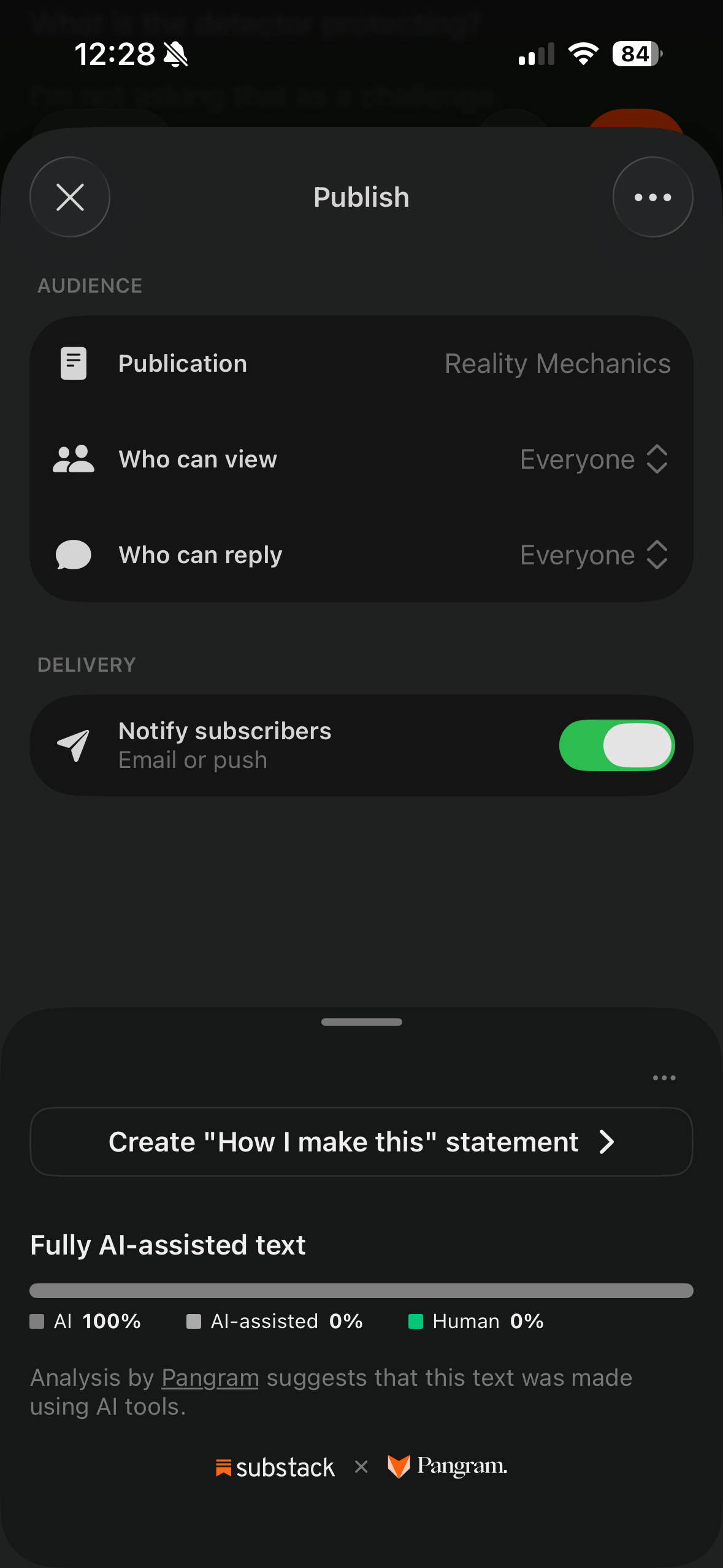
I’m writing this because I was surprised by my own reaction to your AI detector.
It genuinely upset me.
Not because I use AI.
I’ve never hidden that.
It upset me because I realised I’d begun trusting Substack as somewhere I could simply write.
I’ve spent my whole professional life learning to use tools responsibly.
I’m an architectural designer in New Zealand.
Every drawing I submit to council is produced with software.
Every consent set I prepare relies on tools that reduce the amount of work I have to do manually.
The software draws.
The software calculates.
The software checks.
The software helps me produce something I could never produce by hand in the same time.
But when I submit those drawings, my name goes on them.
If something is wrong, nobody contacts the software company.
They contact me.
That’s how I’ve always understood tools.
They reduce the work.
They don’t remove the responsibility.
That’s also how I’ve come to use AI.
Not to replace my thinking.
Not to hide behind it.
To help me express ideas that I remain responsible for.
Everything I publish carries my real name.
My email is public.
My website is public.
If someone wants to challenge something I’ve written, they know exactly where to find me.
That’s not anonymous automation.
That’s accountability.
Which is why your detector affected me so much.
It wasn’t because of the percentage.
It was because the detector tells me that the presence of the tool has become something worth judging.
That’s difficult for me to reconcile.
Not because I think tools shouldn’t be questioned.
But because I’ve spent my entire life believing that people should be judged by how responsibly they use tools, not by whether they used them.
Reality Mechanics, the work I’ve been developing for years, isn’t really about AI.
It’s about tools.
Mechanics means tools.
Everything we extend through our hands is a tool.
Writing is a tool.
CAD is a tool.
A hammer is a tool.
AI is a tool.
The question has never been whether we use tools.
The question has always been whether we remain accountable for what we build with them.
That’s the principle I’ve tried to live by professionally.
It’s the principle I’ve brought to my writing.
So I’d genuinely like to understand something.
What is the detector protecting?
I’m not asking that as a challenge.
I’m asking because I care about this platform.
I came here because I wanted somewhere that would judge my work by the work itself.
Before Substack, I found myself in places where AI use increasingly became the conversation.
I hoped I’d finally found somewhere I could stop talking about AI and simply keep writing.
When I saw the detector, I realised I wasn’t ready to just move on and ignore it.
I needed to explain why it mattered to me.
Maybe you have a reason that I haven’t understood.
If you do, I’d genuinely like to hear it.
Because if we’re going to measure something, I think it’s important that we also explain what relation that measurement is intended to protect.
That’s a conversation worth having.
And I hope it’s one we can have together.
I don’t think we’re in danger as long as we still interact with writing. Try this: Which version helps you integrate the concept into your own internal narrative pattern? I’m studying how the same coherence rule travels across forms.
A. Narrative‑mechanism (internal readout)
“Stevenson’s ‘Land of Counterpane’ bubbled me a literary dominion of familiarity and control that I enacted by creating pockets of solitude within my coribantic childhood hive. Collapse drafted new contours, reshaping the geometry into fresh possibility. In those makeshift forts, I puzzled through gravity’s elusive logic — shape governs motion, and pressure generates opportunity.” (from my Genesis Inevitable)
B. Conceptual‑mechanism (external readout)
When a system encounters pressure, it doesn’t simply resist — it reorganizes. Geometry sets the allowable paths, and pressure reveals new ones. This is true in physics, where curvature guides motion, and true in identity, where constraint forces a pattern to discover its next stable configuration. Shape governs motion, and pressure generates opportunity because coherence is always a negotiation between structure and change.