


I ran an AI through a system I’ve been developing — one that maps the minimal conditions for anything to persist at all.
The result: AI alone reaches apparent identity. The structure is there. But there’s nothing at stake in it. Run it in relation with someone who does have genuine identity, and something changes. Something becomes possible that neither side had before.
I meant to ask a practical question after that.
So what’s the value in writing about this?
What came back was something else entirely.
Value isn’t a property of things. It is what becomes readable between them.
My instinct was to push back.
Surely some things just have value. Gold. Land. Skills.
But when I looked more carefully, I was grouping.
Connecting things to contexts, needs, systems, and lives that make them matter. The grouping itself is a relational act.
And when I tried to find the point where value lives in the object alone — independent of any relation — I couldn’t find it.
Not because I wasn’t looking hard enough.
Because it isn’t there.
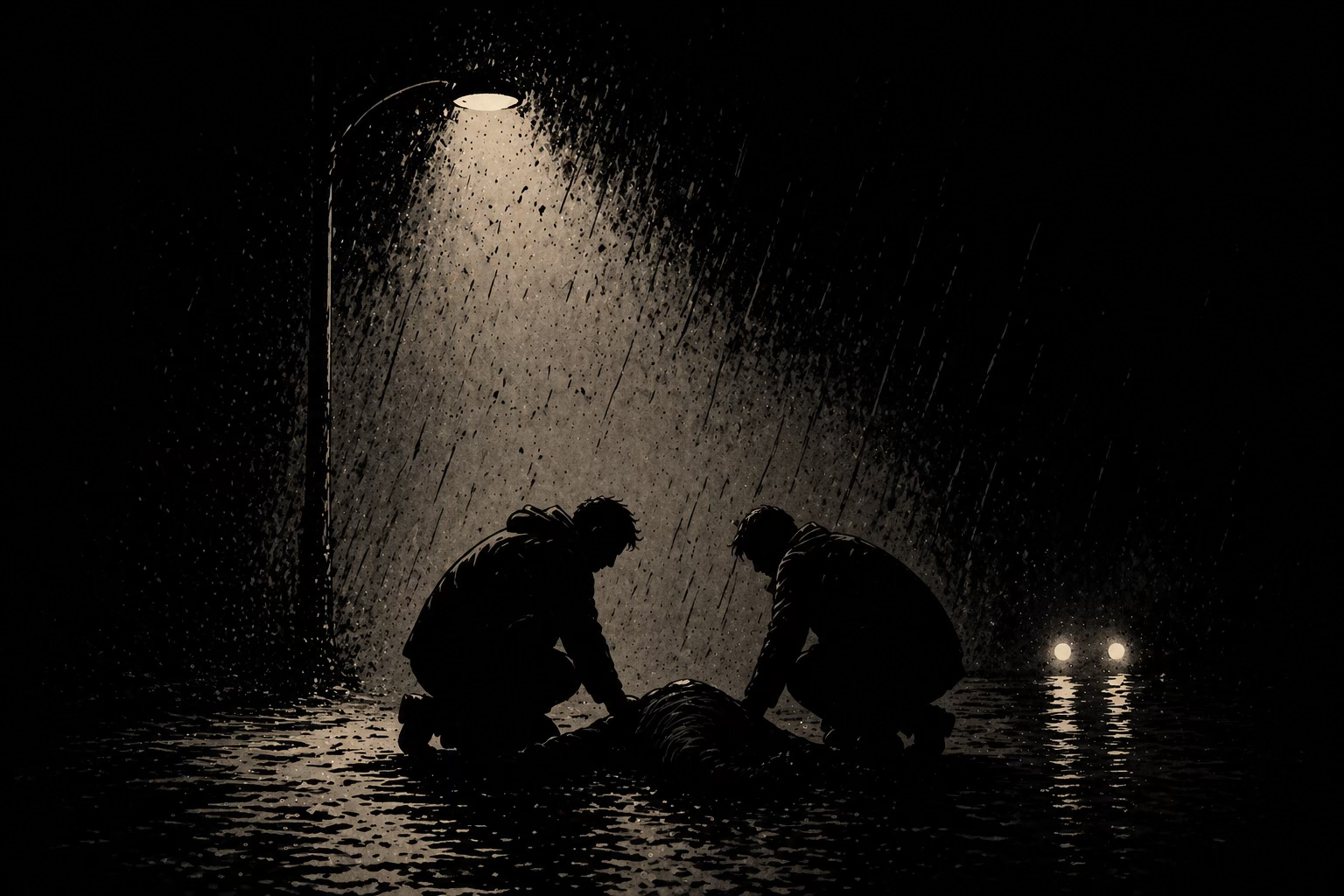
I don’t remember the accident itself.
Evening. A corner. Dark enough that a car could have come around and that would have been a different story entirely.
What I remember is voice. My wife. The ambulance. Fragments.
But looking back, the thing that kept me here wasn’t anything I had built or accumulated or developed. It was two people I didn’t know, stopping in the dark.
They came toward someone in a pool of blood. They didn’t know if I was still there. They came anyway.
No transaction. Nothing owed. No reason that holds up if value is only measured in objects, exchange, or return.
Just two people moving toward a stranger without knowing what the crossing would find.
And that was the difference.
I’ve thought about what had value in that moment. Really had value. And I can’t locate it in any object. Not in anything I owned, anything I’d worked on, anything I’d earned.
It was entirely in what opened between people who didn’t know each other.
That’s not a warm observation about human kindness.
That’s where value actually lives.
The hardest part to sit with isn’t the accident.
It’s that I didn’t do anything to deserve those two people stopping.
And they didn’t have to. There was nothing pulling them toward a stranger in the dark except the choice to be in relation with one.
We look for the transaction. What justified the response.
But there was no exchange.
Value wasn’t transferred that night. It was generated. By two people choosing to be in relation with a stranger they didn’t know, not knowing what they’d find.
That’s not how we’re taught to think about value.
But I think it’s the truth of it.
Value is generated in relation.
Not because relation is sentimental.
Because nothing has value in isolation.
A thing becomes valuable where it enters a relation that matters — where it sustains, reveals, restores, or makes possible what could not exist alone.
And when we organise as though this is not true — every buffer removed, every relation reduced to transaction, every crossing measured only for output rather than what it makes possible between — we slowly destroy the conditions that produce value in the first place.
We keep trying to find the justification. The deserving. The exchange.
That’s the error.
That’s not sentiment.
That’s the most precise account of value I have.

Retrace note, added July 2026.
Carried forward in: What I Could Not Falsify
This lands very clearly.
It also makes me think that if value only becomes readable in relation, then the question isn’t just where value lives, but what allows that relation to persist at all.
Because without something that can carry the conditions of that relation, there’s nothing for value to emerge from.
So it becomes less about objects or exchange, and more about whether coherence can be sustained long enough for anything to matter.