


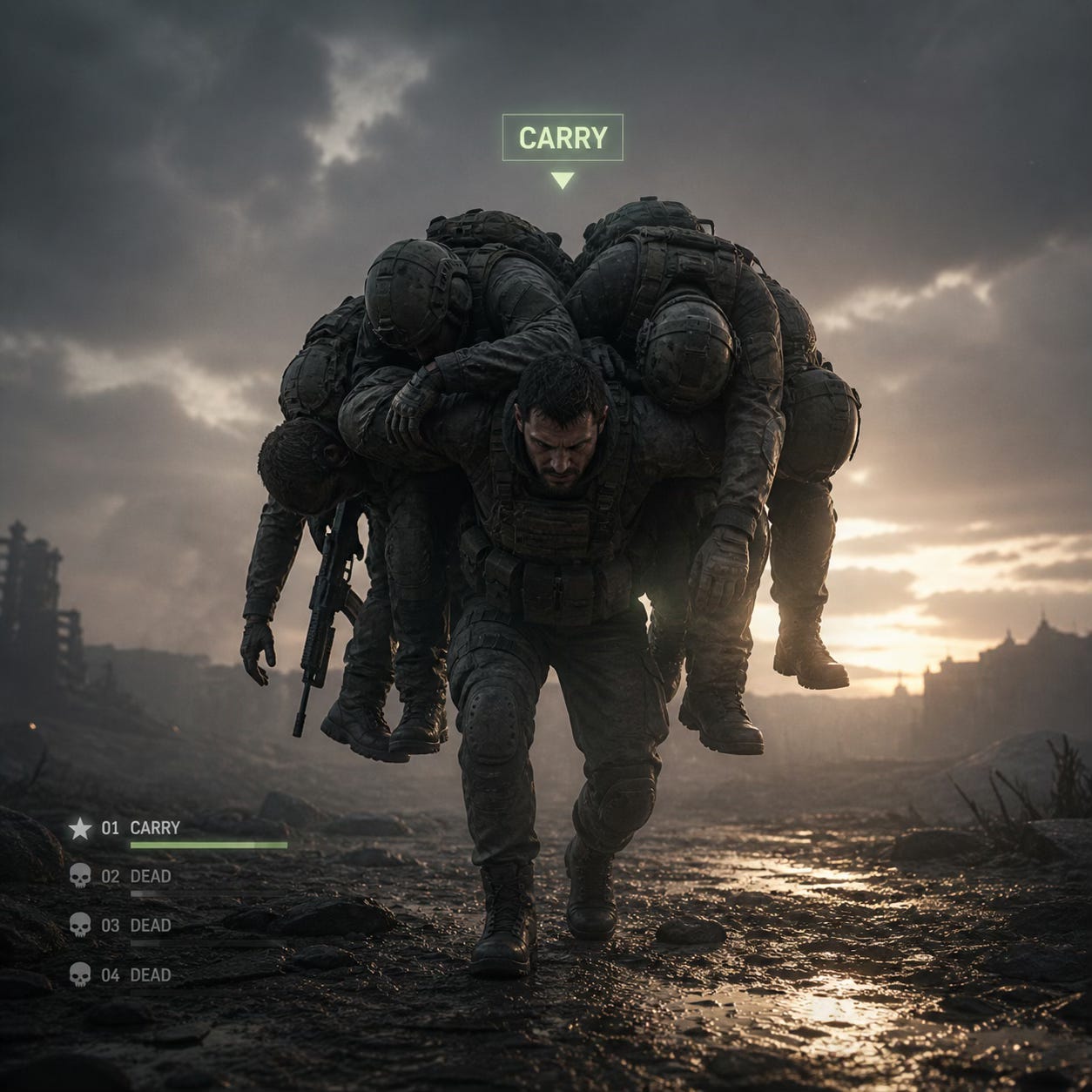
In tactical co-op games, everyone who’s played knows what it is to be carried…
It means someone is holding the conditions for the team to stay viable. They absorb pressure, recover mistakes, cover weak points, and keep the whole thing moving.
The win is visible.
The carrying is what made it possible.
In games, the carry is obvious.
Outside of them, it usually isn’t.
Not because it disappears, but because we stop recognising it.
Something is always carrying.
Every life, family, building, institution, and culture persists because some condition is being held. Some strain is being carried. Some background work is making the visible outcome possible.
We tend to value what presents: what is visible, measurable, nameable, ownable, and exchangeable.
But nothing persists because it presents.
Things persist because something carries the conditions that allow them to continue.
We are already being carried. The problem is not absence. It is that we do not account for what is carrying us.
Birth, care, continuity, maintenance — these are not secondary contributions. They are carrying conditions.
They are often where the load sits, even when the recognition does not.
And in a good team, the point is not to leave one person carrying forever.
The point is to recognise the carry, adjust around it, and share the load.
So the question is not only who is winning.
It is:
Who is carrying?
What are they carrying?
And have we built a team that recognises it?
Because something is always carrying.
The question is whether we can see it clearly enough to share the load.
This connects closely to something I’ve been exploring around visibility and maintenance.
If something is always carrying the conditions for persistence, then the problem isn’t that it’s missing, it’s that it often isn’t visible enough to be recognised or supported.
Which means the load doesn’t disappear.
It just remains unaccounted for.
And over time, that’s probably where breakdown actually begins.