


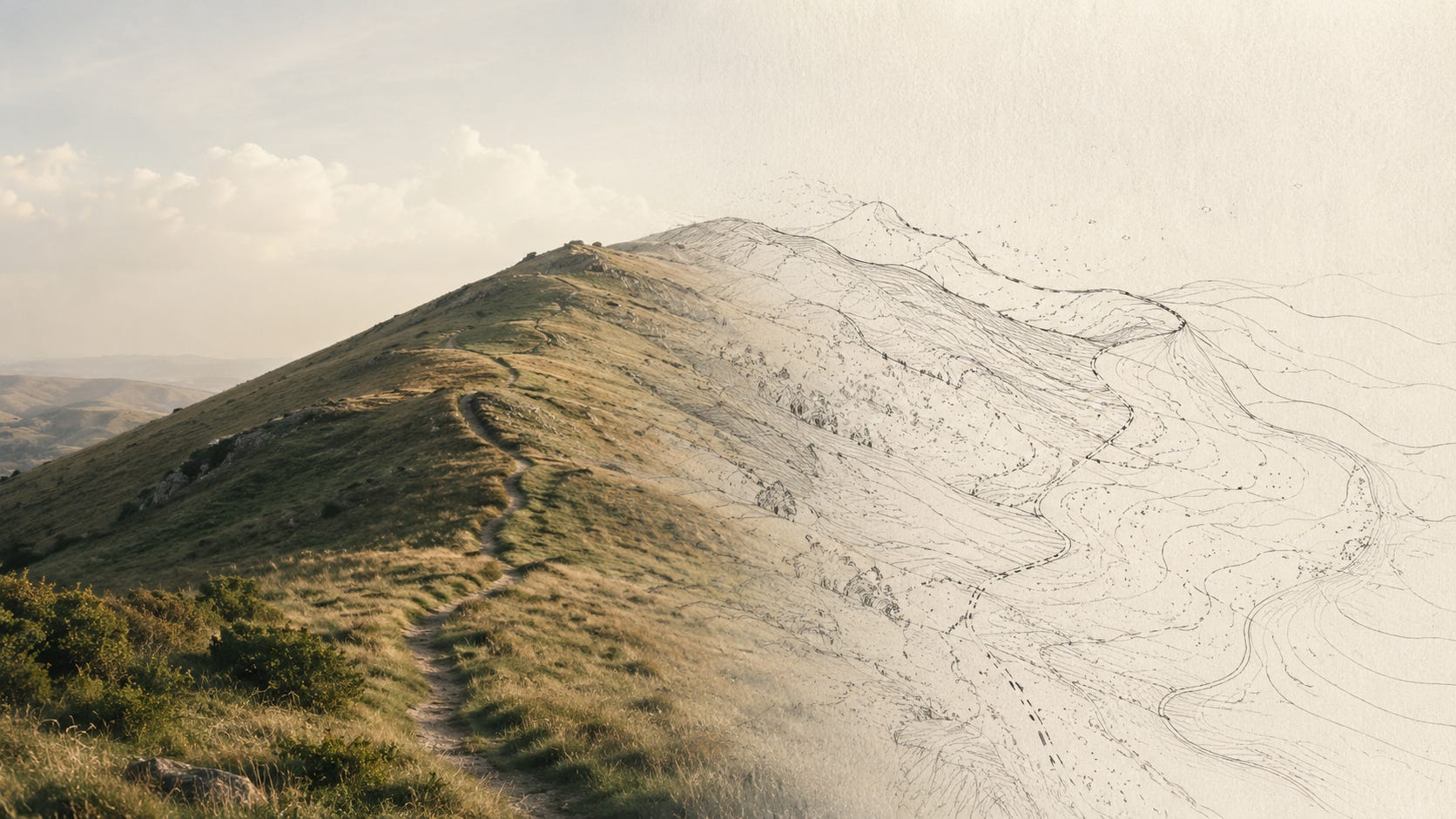
A picture of a hill is not the hill.
It can show the hill. It can point toward it. It can help someone recognise it, remember it, or find their way back to it.
But the picture is not the ground. It is not the slope, the wind, the climb, the view, the weather, the soil, or the changing light.
A map is similar.
A map is not the place. It does not contain the terrain. It does not feel the distance in your legs or the turn in the weather. But a good map can still help someone begin. It can hold a starting point, a path, a direction, and a destination. Once the path has been travelled, it can also help someone retrace their way back.
A word is similar too.
A word is not the thing it names. A definition is not the reality it points toward. A model is not the system. A theory is not the phenomenon. A law is not justice. A metric is not success.
But that does not make words, maps, models, laws, or measurements useless.
It makes them responsible.
The problem is not that humans make maps. The problem is that we forget what maps are for.
A map is not made to replace the place. It is made so the place can be found, crossed, remembered, tested, and returned to.
The same is true of names.
To name something well is not to own it. It is to leave a better way back to it.
This is where many things go wrong. We create words and systems to help us carry reality forward, then start treating the words and systems as reality itself. The category becomes the being. The label becomes the person. The drawing becomes the building. The rule becomes the truth. The map becomes the hill.
Once that happens, correction becomes difficult. If someone questions the map, it can feel as though they are questioning the place. If someone questions the name, it can feel as though they are denying the thing named.
But often the opposite is true.
They may be trying to return the name to what it was meant to serve.
A good name should remain answerable to what it names.
A good map should remain answerable to the terrain.
A good model should remain answerable to reality.
That is the reason for the Atlas.
The Atlas is not a dictionary of final meanings. It is not an attempt to trap reality inside definitions. It is a living map of terms: an attempt to name recurring structures clearly enough that they can be followed, tested, corrected, and returned to.
The simplest way I can currently say it is this:
Relation becoming traceable as order.
That line matters to me because it keeps the work grounded. The Atlas is not trying to impose order over reality. It is trying to trace where relation becomes ordered enough to follow.
A term, in this sense, is not the thing itself. It is more like a direction on a map. It helps someone move toward something that can be encountered, read, and retraced.
This also changes what it means to preserve experience.
Maybe the point is not to be remembered as the mapmaker. The point is for the path to remain findable.
A life meets reality at a cost. We learn through mistakes, repair, care, failure, work, grief, love, responsibility, and consequence. If none of that becomes traceable, then the next person — or the next generation — has to meet the same reality without the benefit of the path already travelled.
So perhaps the deeper task is not to preserve ourselves as monuments.
It is to preserve the trace of what experience taught us.
Not so others have to agree with us.
Not so the map becomes final.
But so they do not have to begin blind.
Right now the Atlas is a living body of terms — one person's attempt to map what has become readable through experience.
But over time, I hope it can become something more: a place where lived experience can be offered as trace. Where people can show what held, what failed, what carried, what harmed, what helped, and what became clearer through consequence.
A person's experience does not need to become a theory to matter. It does not need to be final. But if it can be read clearly enough, it can enter a wider set of relations: something another person can test, correct, follow, or return to when they meet a similar part of reality.
A trace does not have to be complete.
It might be:
This is where I got it wrong, and this is what it cost.
Or:
This held for me, until it didn't, and here is where the boundary was.
Or simply:
I met this part of reality, and here is what I came back with.
If something in your experience has clarified into a term — something you have tested against reality and returned with — I would genuinely welcome it. Terms that hold can find their place in the Atlas.
I also hope the Atlas can become useful beyond individual reading.
As systems like AI become more involved in how knowledge is searched, summarised, generated, and acted on, the need for traceable structure becomes more important, not less. If a system can produce words without knowing what those words are answerable to, then the map can drift very quickly from the terrain.
My hope is that the Atlas can eventually offer something different: not just more content, but a structure of relation that can be followed. A way for human experience, terms, dependencies, and corrections to remain connected enough that both people and systems can retrace where a read came from, what it depends on, and what it remains answerable to.
That is the future-facing hope of this work.
Not a monument.
Not a closed system.
A growing map of traceable experience, where relation becomes readable enough that people — and perhaps one day other systems — can find their way through it without losing the path back to reality.
The Atlas is live at atlas.realitymechanics.nz
Retrace note, added July 2026.
Builds on: Reality Mechanics — Version 01
In the Atlas: The Atlas — live surface
Perhaps we don't only confuse the map for the hill.
Sometimes we confuse a single encounter with the hill for the hill itself.
We remember the weather, the season, the climb, and the person we were when we stood there.
Then we mistake that memory for the mountain.