


I had to count the rotation multiple times before I understood the answer.
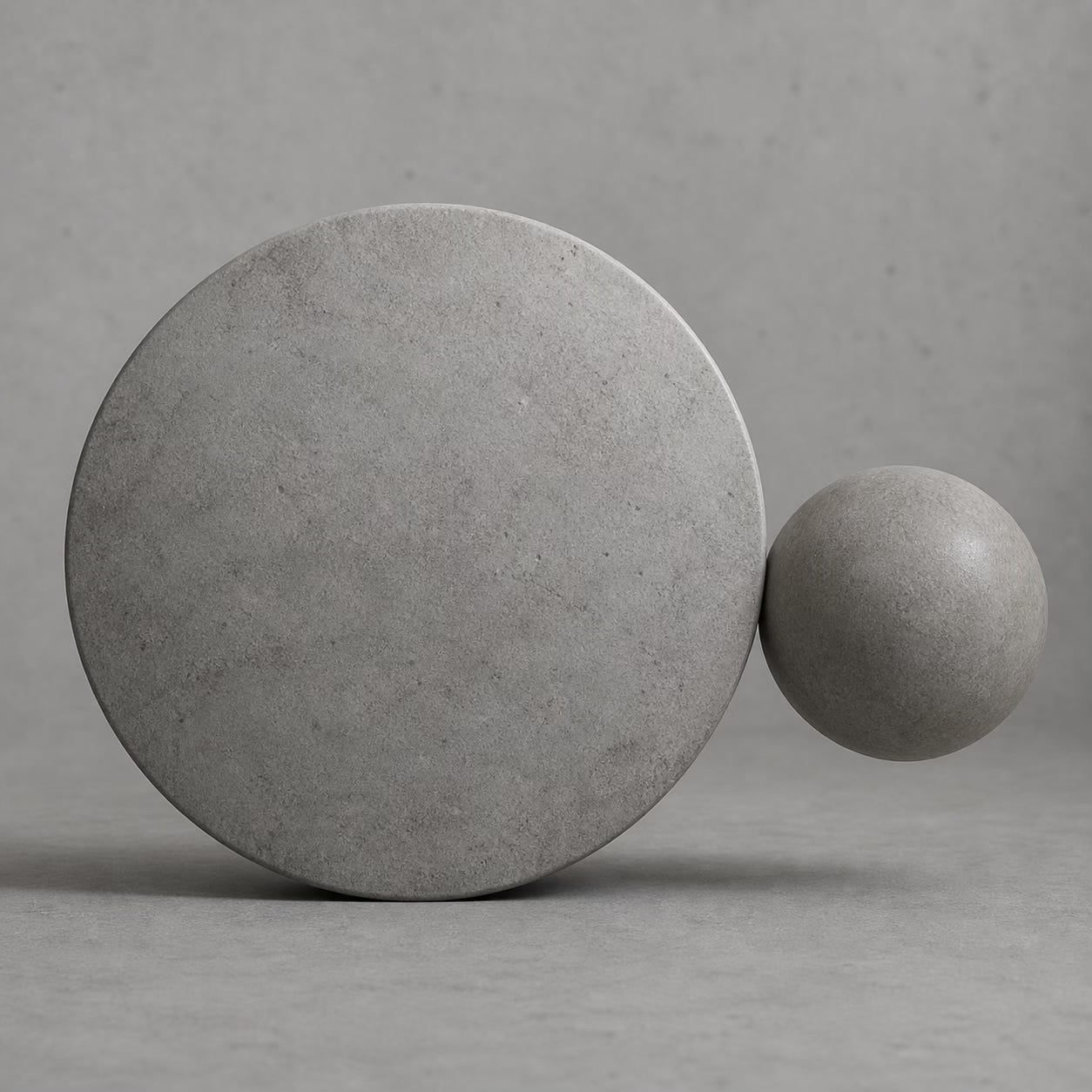
Place a small circle against a larger circle three times its radius. Roll the small circle around the larger one without slipping. How many times does it rotate before it gets back to where it started?
Most people say three.
The answer is four.
It was a real SAT question once. Every option offered was wrong, including “three.” The correct answer was not on the list.
The maths is clean. If the fixed coin has radius R and the rolling coin has radius r, the rolling coin’s centre does not trace a circle of radius R. It traces a circle of radius R + r. So when R = 3r, the rolling coin rotates (R + r) / r = 4 times, not three. That extra distance is enough, exactly enough, for one extra rotation. Holonomy gives the same result more generally; it is the same structure that produces Berry phase in quantum systems.
But the maths explains the quantity. It does not explain why one continuous rolling relation produces different readings depending on where evaluation closes.
So I tried to find where the extra rotation was happening.
At every point of contact along the path, the circle is doing exactly what rolling should do. Local rotational displacement matches local arc length. Nothing extra is happening at any moment.
The extra rotation is not sneaking in anywhere along the way.
It only shows up when the path closes.
I want to hold this carefully.
The contact holds. The no-slip condition holds. Rolling continues. That is one evaluation, complete in itself, moment by moment.
The other evaluation, what the closed traversal makes readable, is something else.
Not added later. Not somewhere we missed. It belongs to closure itself.
It is real, but it has no local address.
The relation holds. What becomes readable depends on where evaluation closes.
The same shape appears in the sky. The Earth completes about 366.25 sidereal rotations per year and 365.25 solar days. The difference of one is the same surplus, for the same reason. You cannot pin that rotation to any particular moment in the orbit. It is not somewhere on March 14th. It belongs to the closure of the orbit, not to any point along it.
I think this is more general than the rolling circle example.
We keep trying to read things in the moment. The conversation. The day. The decision. The contact point.
And some things are readable there. Local continuity is a real evaluation.
But some things only become legible at closure: relationships, practices, years.
Trying to find them locally is not failure of attention. It is looking for them where they do not live.
The rolling circle is unusual because the two evaluations are visibly separate: one continuous system, one minute of motion, and you can watch the structure pull apart. Most things mix the two together.
Rolling does not.
That is why I wrote it up. It is a worked example for Reality Mechanics, the framework I have been developing for how identity persists through maintained relation. The rolling circle turned out to be the cleanest physical case I have found of something the framework needed: a place where maintained relation, carried difference, and downstream readability are all visible without tangling.
The rotation was never missing. It just did not live where we were looking.
Paper:
[The Rolling-Circle Paradox as a Worked Example of Evaluation Scope in Reality Mechanics]
Framework:
[Reality Mechanics v5.2: The Structural Conditions for Identity Persistence]
Note added July 2026.
The result in this essay — that some conditions are real but have no local address, and become readable only where evaluation closes — stands, and is load-bearing in the current structure.
The framework document linked below it, Reality Mechanics v5.2: The Structural Conditions for Identity Persistence, is an archived working iteration: the iterations were later archived as they stood and replaced by the issued Reality Mechanics v01.
The vocabulary in that title has since changed; where and why: What I Used to Call Persistence.
Carried forward in: Reality Mechanics — Version 01
In the Atlas: Closure Scope