


I learn drum beats by dividing timing between limbs.
One limb lands relative to another, or relative to the pulse. With practice, I stop having to think about each movement separately. The relationships become something I can carry.
But I also learnt that those relationships form in relation to the instrument I practise on.
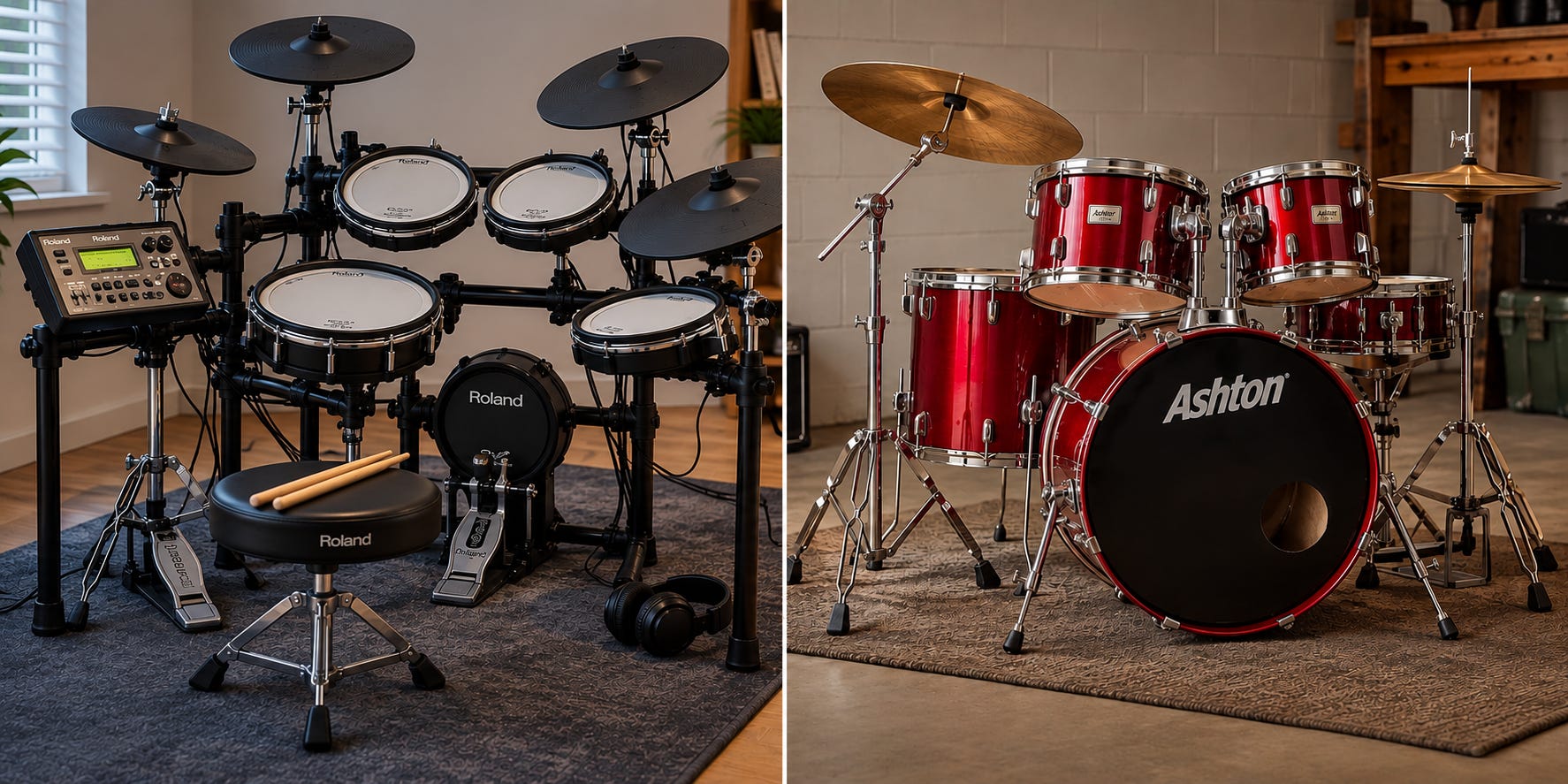
I started on an entry-level Ashton acoustic kit. Later, my dad bought me a Roland TD-12 electronic kit.
When I attended performing arts school in Auckland in 2008, I was living in a flat. With headphones, I could play along to songs and practise without disturbing the neighbourhood. I could hit the drums hard and still control the volume anyone else heard.
Later, my brother and I played covers at bars, wineries, cafés and weddings. The electronic kit worked well there too. It took up little space and I could control the output volume without changing how I played.
An acoustic kit relates those things differently.
Volume, movement and sound are more directly connected. Where I strike a drum, how hard I hit it, whether I catch the rim, how I control the hi-hat — all of these change what comes back.
Most of my playing transferred between the two.
But not all of it.
Sometimes my electronic kit was not available and I had to play whatever acoustic kit was already on stage. I found that pretty intimidating.
I could still play.
My timing was what I trusted. I would stick mainly to the kick, snare, hi-hat, ride and crash. Those relationships were familiar enough that I could carry the song even when the kit itself was not.
I mostly avoided the toms unless a song explicitly required them.
Even my fills tended to stay within the parts of the kit I already trusted. Rather than adding more relationships, I filled the relationships I already had.
And I had one slightly embarrassing workaround.
I struggled with controlling the full range of an acoustic hi-hat with my foot. So I would clamp it low enough that even when I opened it completely, the cymbals stayed close enough to give me a controlled sizzle.
I reduced the range to something I could reliably control.
The difference worked the other way too.
Drummers who mostly played acoustic kits also had to adjust to my electronic kit. Things they were used to doing on an acoustic drum did not always produce the same result electronically.
Neither instrument showed me which kind of drummer was better.
What became obvious was which relationships transferred.
When the conditions changed, some relationships came with me easily. Some needed adjustment. And when I was under pressure, I fell back on the relationships I knew I could carry.
That is what interests me about AI and reasoning.
AI changes the conditions in which reasoning is practised. Some relationships become easier to form or explore. Some are changed by the tool. Some we may no longer have to carry ourselves.
I don’t know whether that makes our reasoning better or worse.
But the drum kit leaves me with a better question:
When the conditions change, which relationships can I still carry?