


The same structure shows up across very different systems:
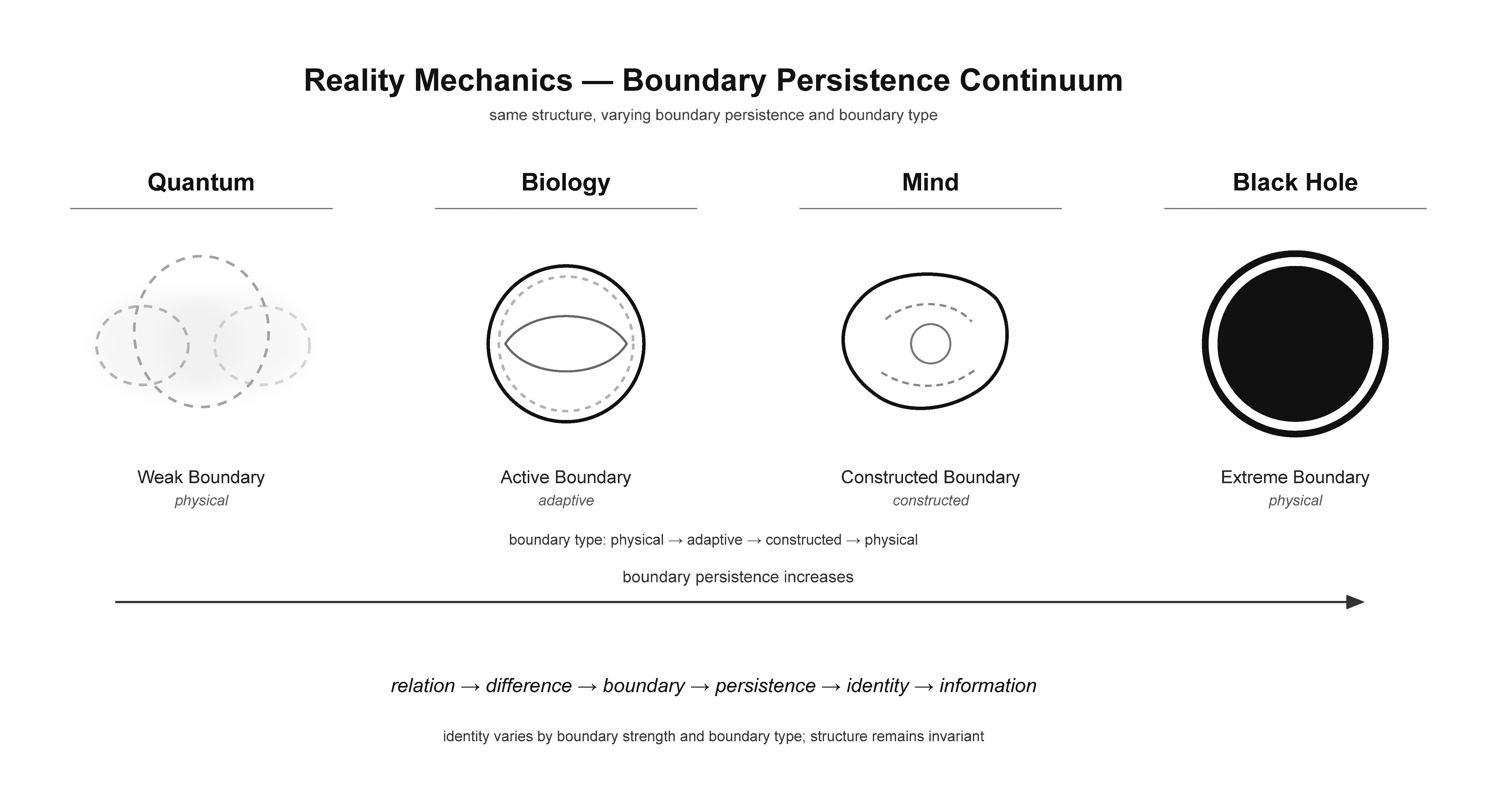
In my last post, I wrote about something that became clear to me the hard way:
Stability isn’t something you have.
It’s something that is maintained.
Since then, I’ve been trying to describe what that actually means.
Not as a feeling.
Not as advice.
But structurally.
What I kept coming back to was this:
Anything that exists — a person, a system, a business, a cell — only exists for as long as something holds it together.
That “something” isn’t a thing.
It’s a boundary.
A boundary is what separates “this” from “not-this.”
Your skin.
A cell membrane.
A company’s operating constraints.
A sense of self.
An event horizon.
Different forms. Same role.
They are all places where something is being held apart from everything else.
What matters isn’t the boundary itself.
It’s whether it persists.
Because the moment that persistence fails, the thing it was holding together stops existing in the way it did before.
It doesn’t disappear.
It redistributes.
That led me to a sequence that seems to show up everywhere I look:
relation → difference → boundary → persistence → identity → information
Relations exist
Differences emerge
Boundaries form
Persistence determines whether they hold
Identity appears where they do
Information is what crosses them
Remove persistence, and identity disappears.
What’s been most interesting is that this doesn’t seem to depend on domain.
At one end, boundaries barely hold.
At the other, they become almost absolute.
In between, you get:
Living systems — actively maintaining boundaries
Human systems — often constructing them
Different strengths. Different types.
Same structure.
You can feel this directly.
When you’re overwhelmed, it’s not abstract.
Something is pushing on your boundary.
Your ability to maintain a coherent “you” is under load.
When something gets through — a conversation, a shock, a realisation — that’s not metaphor.
That’s a relation crossing your boundary and changing what can persist inside.
When things hold together longer than they should — a team, a relationship, a person —
that’s usually because something else is helping hold the boundary from outside.
Looking back, both of the events I wrote about last time make more sense in this light.
The first was a failure of boundary.
The second was external support stepping in to hold one.
Same structure.
Different conditions.
What I’ve been working on is a way to describe this cleanly, without tying it to any one field.
I’ve called it Reality Mechanics.
Not because it introduces anything new, but because it describes what must already be true for anything to exist at all.
If you zoom out far enough, the categories we normally separate — physics, biology, psychology — start to blur.
They begin to look less like different kinds of things,
and more like different ways boundaries manage to persist.
What changes is not the structure.
It’s:
how strong the boundary is
how it’s maintained
I’ve put the current version of the framework up here:
It’s minimal by design.
No assumptions about scale.
No domain-specific language.
Just the structure.
I don’t see this as finished.
But it’s the first version that feels like it holds.
Across domains. Across scales. And increasingly, in practice.
If the last post was about feeling stability,
this is about what seems to be producing it.
And if there’s one thing I’m increasingly convinced of, it’s this:
Most of what we experience as “problems” are, at some level,
failures of boundary persistence under load.
I’ll keep exploring this from different angles.
For now, this is the clearest I can make it.
Retrace note, added 21 July 2026.
This essay is the first public naming of Reality Mechanics, and it reflects the framework as it then stood.
It uses an early sequence — relation → difference → boundary → persistence → identity → information — in which persistence is a step of its own, and identity appears where boundaries persist. That ordering has since been refined: the current Atlas carries no Persistence term.
What this essay called persistence was separated into distinct conditions — carrying, compatibility, and recurrence — and identity was re-placed as sustained distinguishability, a produced distinction rather than a step.
The essay's core observation stands: boundaries are maintained, not possessed, and most problems are failures of boundary persistence under load. It stays as written; the change in language is part of the trace.
Where and why: What I Used to Call Persistence.
This is a really clean articulation — especially the way persistence sits at the center of everything else.
The sequence from relation → boundary → persistence → identity holds together well across domains.
One thing I keep wondering, reading this from a systems/decision perspective, is how the framework treats cases where persistence doesn’t fail — but starts to hold the wrong thing.
Because in many systems, boundaries don’t necessarily break under load.
They adapt.
And sometimes they adapt in ways that preserve local coherence,
while gradually decoupling from the larger structure they were part of.
So identity persists —
but in a shifted or narrowed form.
From the inside, the system still “holds.”
But what it is holding has changed.
Which makes it harder to detect, because nothing has clearly collapsed.
It has just stabilized around a different configuration.
So I’m curious how Reality Mechanics would describe that state.
Not boundary failure,
but boundary persistence under misalignment.