


Today is my daughter’s birthday.
Her name is Ember-Ruby. She was born in 2014, at just over 20 weeks’ gestation. She lived for about three hours and died the same day.
There is grief in that. The grief of losing a child, but also the grief of carrying a life that does not continue in the way you expected it to.
I think grief is often wider than the loss itself.
When something real begins to change the direction of your life, you start adjusting around it before it has fully arrived. That might be a child, a relationship, a home, or any future you have begun moving towards.
Your thoughts change. Your plans change. The shape of your life begins to bend around what you are preparing to carry.
When that future is lost, you do not simply return to the path you were on before. You are left carrying the plans, the imagined future, and the version of yourself that had already begun forming around it.
That has to go somewhere.
For me, some of that grief eventually found a place in the name of my business: Ember-Ruby Design Service.
It was one way of carrying something I could not fix.
Looking back, one of the most important things I learned was not only about grief. It was about what happens when the language used by a system does not carry the reality experienced by a person.
We knew there was a boundary.
If Ember-Ruby’s heart stopped before she was born, the timing would determine how what happened was recognised. Before 20 weeks, it would be classified as a miscarriage. After 20 weeks, she would be recognised as stillborn.
Stillbirth would have been a terrible truth, but it would have been the truth. She had lived. She was our daughter.
What frightened us was that, before that boundary, the language used by the system might not carry that reality.
There are medical realities, bodily realities, and things no person can simply decide their way through.
Reaching that boundary was not an achievement, and failing to reach it would not have been a failure.
But neither was it merely an administrative detail.
There was almost no fluid around Ember-Ruby. Ultrasound scans showed that she was alive and that her heart was beating, but we did not know whether it would still be beating when she was born.
My wife carried Ember-Ruby physically. She also carried the strain of knowing what the timing might mean if Ember-Ruby’s heart stopped before birth.
I could stand beside her, but I could not carry that for her.
In the end, Ember-Ruby was born alive.
Her heart was beating, so her birth and her later death could both be officially registered. There was a birth certificate and a death certificate.
That mattered more than I understood at the time.
She was not stillborn.
Her heart was beating when she was born. She moved in my hands. We were told that her lungs had not developed enough for her to breathe, but her heart continued beating for about three hours. A nurse checked it, and when her heart stopped, she died.
Her death certificate records her age as three hours. Her cause of death is listed as extreme prematurity.
Those details matter to me.
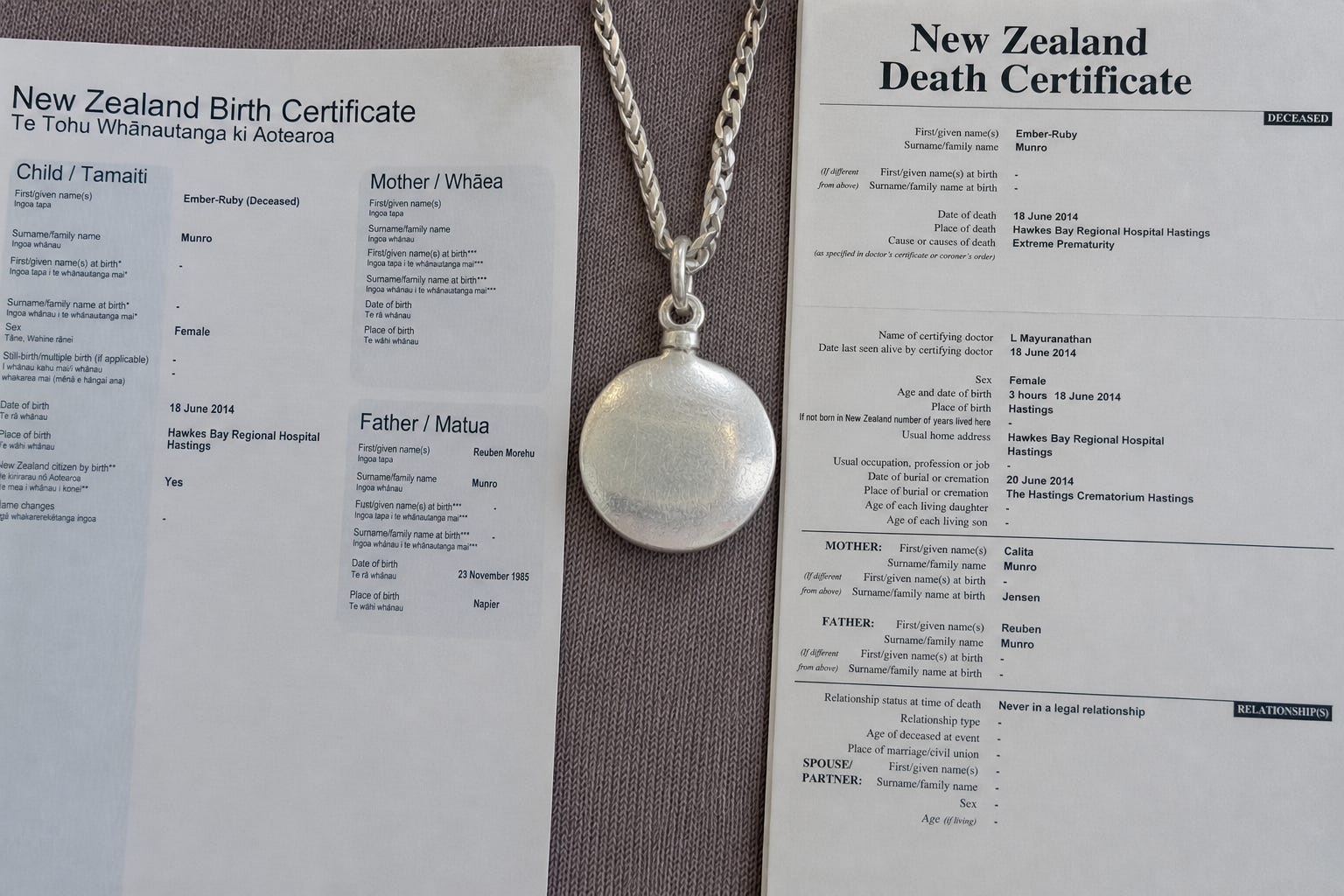
She was not just an idea, or only a pregnancy. She was not merely a medical event.
She was our daughter.
What unsettled me was how close that reality came to being described differently.
Had the timing changed, Ember-Ruby would not have been less real. What happened to her would not have been less real. Our grief would not have been less real.
But the system might have used another category.
At the time, I even approached Guinness World Records about having her recognised as the youngest baby to be born alive and die at just over 20 weeks. Looking back, I can see that this was probably the wrong place to take that need.
But the need itself was real.
I was not truly chasing a record. I was trying to protect what had happened from being flattened into a category that could no longer hold it.
I wanted something outside us to acknowledge that she had been here.
A category can help a system record what happened. Sometimes that recognition can carry part of the truth and give grief somewhere to stand.
But a category can also cover reality. It can make an experience easier to process administratively while making it harder for the people involved to describe what they lived through.
The category may be legally, medically, or procedurally correct and still fail to carry the whole reality.
We need categories. Systems could not function without them, and people need words for complicated experiences.
The problem begins when the category replaces the thing it was meant to describe.
I know that I was fortunate Ember-Ruby’s name could be recorded. Her age could be recorded. Her birth and her death could be recorded.
That recognition did not remove the grief, but it meant I did not have to spend the rest of my life fighting for her to be named as what she was.
Other people are not always given that.
Some are left with a word such as “miscarriage.” I understand the medical meaning of the word, and I know it is not intended to assign blame. But words gather meanings beyond their technical definitions.
To some people, “miscarried” can sound as if the mother carried something wrongly, rather than that she carried something real and then lost it.
The word can place the weight in the wrong place.
I think many people know some version of this—not necessarily through the death of a child, but through any experience in which the available language does not quite match the reality they lived.
Sometimes the struggle is not only to survive what happened. It is also to stop what happened from disappearing inside the words used to describe it.
As a father, I do not know whether I could have put that struggle down if Ember-Ruby had been recorded differently.
Not because I could not accept the grief, but because I could not accept the reality of her life being described in a way that did not carry what happened.
That is what I now ask of language: not that it contain the whole of an experience, because no word can do that, but that it continue pointing towards the reality from which it came.
My daughter’s name is Ember-Ruby.
The business carries her name, but her name is not branding. Nor is it an attempt to turn grief into something useful.
It is simply one of the places where the reality of her existence is still carried.
And when I speak about her through the business or on her birthday, I do not mean that I carried any of this alone.
My wife carried Ember-Ruby in a way I never could. She carried her physically, and she has carried the loss in her own way since.
What I have written here is only my side of trying to acknowledge what happened.
She was born.
She lived for three hours.
She died.
Her name is Ember-Ruby.
This is beautiful. A daughter is a daughter from the day that blue line appears on the test. Her time growing inside your wife, her three hours outside. So precious, no matter the medical terminology. A beautiful name, that conjures the image of an Ember, small but burning bright. Forever. 🙏
RIP Ember Ruby